Iraqi Meatballs with Apricots and Tomatoes: Not Just For Passover

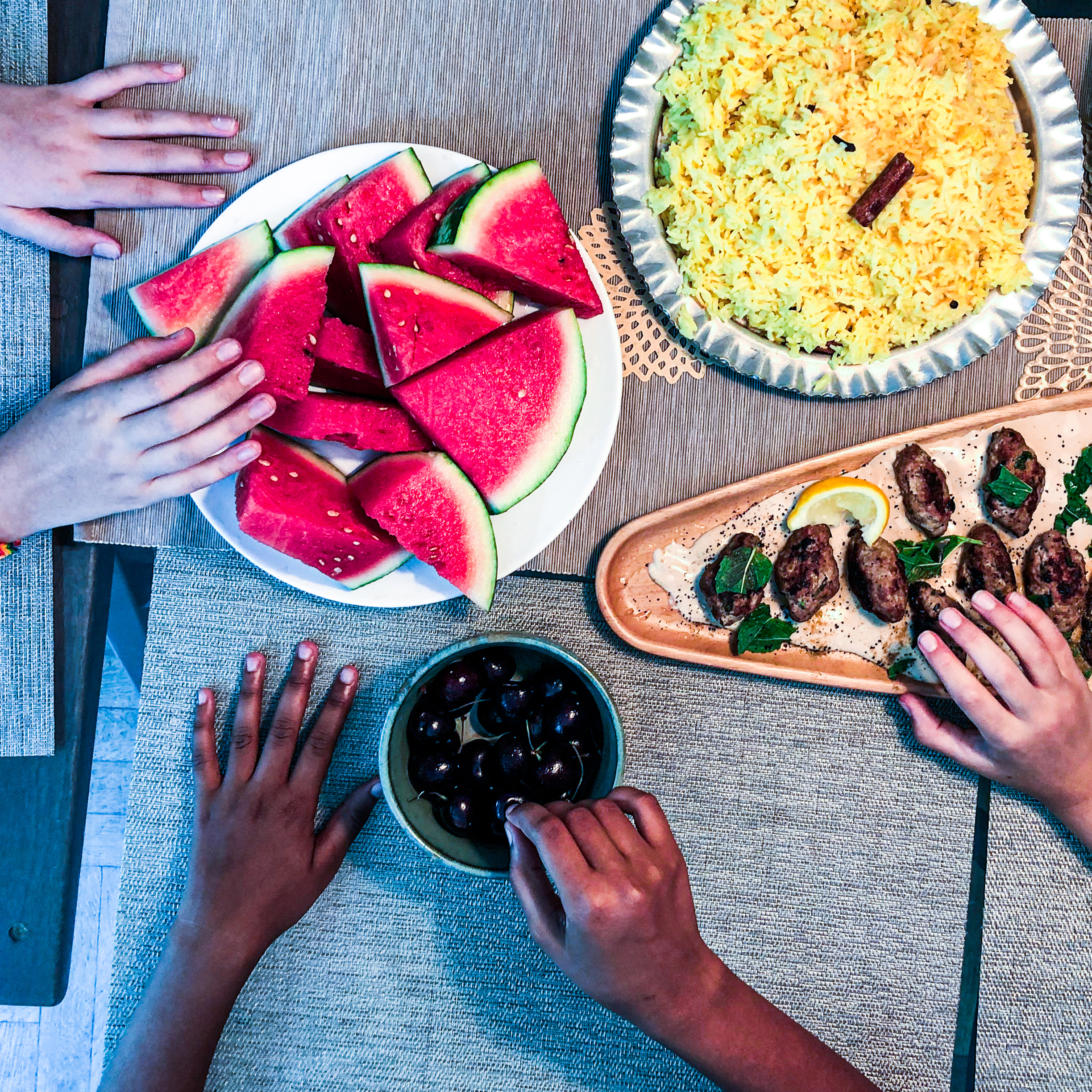
Stew_Meatballs_Apricots_Iraqi_BlogEven though this may be a dish served for an Iraqi Passover Seder meal, it is not something that is reserved solely for this holiday alone. Iraqis may prepare this for most any special occasion, including Rosh Hashanah as well as Shabbat. The sweet and savory combination of beef and/or lamb cooked with dried apricots is distinctly Middle Eastern, and has carried over into the Sephardic palate.

For the Sauce:
1 cup dried apricots
1/2 cup pitted prunes
¼ cup golden raisins
2 tablespoon canola, vegetable, or olive oil
1 cup finely chopped yellow onions (about 1 medium)
One 6-ounce can (about ½ cup) tomato paste
2 tablespoons freshly squeezed lemon juice
3/8 to ½ teaspoon kosher salt (depending upon how salty your tomato paste is)
¼ teaspoon ground ginger
¼ teaspoon ground coriander

For the Meatballs:
½ pound ground lamb
½ pound ground beef
¼ cup cold water
2 teaspoons kosher salt
Freshly ground black pepper
¼ teaspoon ground allspice
3/8 teaspoon ground cinnamon
1 teaspoon ground coriander
¾ teaspoon ground ginger
¼ teaspoon ground cloves
2 to 3 tablespoons canola or vegetable oil (for greasing your hands and browning meatballs)

PREPARE THE SAUCE:
1. Soak the dried apricots, prunes, and raisins in a small bowl with 3 cups hot water. Set aside.

2. Heat the oil in a large saucepan over medium heat and cook the onions, stirring, until soft and golden but not brown, 3 to 4 minutes. Remove from the heat and pour into a large mixing bowl, keeping the saucepan for frying the meatballs (do not wash!).

3. Add the tomato paste and lemon juice and mix until the tomato paste is smooth and blended into the onions.

4. Add the salt, ginger, and ground coriander and mix well.

5. Add the dried fruit with all of its soaking water and mix well to combine. Set aside to prepare the meatballs.

PREPARE THE MEATBALLS:
6. Combine all the meatball ingredients (except for the oil) in a medium-size bowl squeezing it together with your hands until well blended and the meat is very soft.

7. Wash and dry your hands, then coat them lightly with extra canola or vegetable oil. Taking 1½  tablespoons of meat, roll it into a smooth meatball. Place the meatball onto a large platter or plate and continue to roll until all of the meat is used, oiling your hands if necessary.

8. Pour 1 tablespoon of canola oil into the same large saucepan that cooked the onions and reheat over medium-high heat for 1 minute. Place the meatballs into the saucepan and brown on all sides, about 10 minutes total.

FINISH THE STEW & SERVE:
9. Pour the sauce mixture over the browned meatballs and mix gently, taking care not to break the meatballs. Bring to a boil over high heat, uncovered, then lower to a medium heat and slow boil until sauce has thickened and reduced slightly and fruit is very soft or almost mushy in texture, about 1 hour.

10. Serve hot over white rice or as is alongside cooked vegetables or potatoes.

Yield: Serves 4 to 6 (Makes About 5 Cups / About 1½ Dozen Meatballs Plus Sauce)

Minas, Meginas, and Maienas: The Quintessential Sephardic Dish?

Pie_Matzah_Cheese_blog

Mina de Maza with Cheese

Through my Passover research I came across the concept of a layered matzah pie that is very popular in the Sephardic communities of Turkey and parts of Greece, but not something that I was not at all familiar with in the Syrian community. The filling layered in-between softened pieces of matzah vary from beef and lamb, to spinach or just cheese, and all are baked into delicious pies resembling a lasagna. Interestingly enough the name for this type of layered pie varies. In the community cookbook by the Sephardi Ladies of Zimbabwe I came across Megina de Karne, and while interviewing Greek and Turkish Jews, I learned about Mina de Maza (see photo at left) and Mina de Carne. An Italian version called Matzah Scacchi has a very different name but the concept of layering a meat filling in-between matzah then baking it appears to be a Sephardic influence. Although by name the Algerian Megina indicates similar roots, it is more of a large frittata-like omelet consisting of many eggs, ground beef, and potatoes (I wonder if the combination of many eggs mixed with meat and baked into a pie is the part that was carried over in the name?) The closest dish that I can compare to is the Greek Spanikopita which uses phyllo dough with a traditional filling of spinach and cheese.

QUESTION:
Does anyone know if any of these words (mina, megina, maiena, meyina)
derive from Spanish, Ladino, Turkish, Greek, or Arabic?

Streit’s Matzo Documentary: A Recipe for Success on the Lower East Side

Window sign at Streit's matzah factory on the Lower East Side; Photo by ©Liz Rueven, www.kosherlikeme.com.

Window sign at Streit’s matzah factory on the Lower East Side;
Photo by ©Liz Rueven, http://www.kosherlikeme.com.

Streit’s Matzos has been around since the early 1920s and is the last family owned factory of its kind still standing in the United States. Like only a few places still functioning on the Lower East Side, Streit’s represents an important party of Jewish-American history. It’s worth stopping by to see (and taste) for yourself what makes this place so special!

Check out the campaign to make a documentary about Streit’s!

Now that Passover has Passed Over…

Other than Chanukah, Passover is without a doubt the busiest time of year for me professionally. During the month and a half leading up to this year’s holiday life was good and busy. I taught several Passover cooking classes in 3 separate schools, prepared 3 full Seders for different clients (before even getting to my own 2 Seders!) and with whatever time I had left posted diligently on my new Passover blog. Now that the holiday has come and gone I feel relief while at the same time a bit of a letdown. During Passover I had to keep reminding myself to not inadvertently eat bread products or chametz, while now I have to remember that I can. Now’s the time to get back to writing and doing research for my Sephardic Passover cookbook which was the original motivation for my blog. I will still post to my blog but probably not as often.

Question: What are you doing with any leftover or unopened boxes of matzah?

I know that for me any matzah will be put to good use at some point since I have many Passover recipes to write and develop for the cookbook. Last week I stopped by Streit’s matzah factory down on the Lower East Side for the unveiling of the newest post-Passover matzah flavor: poppy seed and onion. You know what? It was surprisingly good! And even though I have had my fill of matzah for some time, I can see why this is a year-round industry. Stay tuned!

Round vs. Square: How do you take your matzah?

An interesting article was written Passover week in The New Yorker about Manischewitz and how they turned commercially made matzah into such a successful business year-round. One of the secrets? Turning the usual handmade circular matzah into a square!
Read for yourself!

Back to Bread: Moroccan Cigares aux Amandes

CigaresAmandes_BlogPassover has passed over and we are now back to eating our favorite breads, cakes, cookies, crackers, and yes, pasta. For our break fast (from bread) we decided to have a simple pasta with sauce and cheese (other choice was pizza), a cold beer, and some delicious Moroccan pastries called, Cigares aux Amandes, which are a specialty served during Mimounah, the festival celebrated at the end of the Passover holiday. Below is a recipe that I later developed after having first learned them from Fatima, a Moroccan woman I met while visiting my husband’s family in France. Because France has a large North African population from Morocco, Algeria, and Tunisia, one can easily purchase store-bought leaves of dough in a package to roll and fill and make these cigares, but in the U.S. I have only seen them in some of the more specialized Middle Eastern stores in places like Queens and Brooklyn. Instead one can make a version that using the Greek style of thin phyllo pastry, which also rolls well but is a bit more flaky and delicate to work with.

Cigares aux Amandes:
Moroccan Phyllo “Cigars” with Almonds and 
Honeyed Orange-Blossom Syrup

Yield: Serves 12 / Makes 2 Dozen Cigares

For Filling
1 cup blanched whole almonds
½ cup plus 2 tablespoons granulated white sugar
1/4 teaspoon ground ginger
1/4 teaspoon ground cloves
1/4 teaspoon ground cinnamon
1 small egg or ½ large egg, lightly beaten
1 to 1½ teaspoons orange-blossom (flower) water

For the Cigares Using Phyllo Dough:
2 sticks sweet, unsalted butter, melted
½ pound phyllo dough (half of a 1-pound box), thawed according to package directions
2 to 3 cups vegetable oil, for frying

For the Cigares Using Feuilles de Brick:
6 pieces of feuilles de brick
1 large egg white, lightly beaten
¼ to ½ cup canola or vegetable oil, for frying

For the Syrup:
1 cup clover or orange-blossom honey
2 teaspoons orange-blossom water

For Serving (Optional: may choose which you prefer):
Confectioner’s sugar
Ground cinnamon
Sesame seeds


PREPARING THE FILLING:

1. Pulse together whole almonds and sugar in a food processor until finely ground into a meal.

2. Add ground ginger, cloves and cinnamon and pulse together again to blend.

3. Add eggs and orange-blossom water and pulse one last time to make an almond “dough” that is
soft and paste-like. Set aside.

FILLING, ROLLING, AND FRYING (using phyllo dough):
4. Unroll the phyllo pastry dough on a countertop and gently smooth out with dry hands. With a kitchen scissors or very sharp knife, cut the phyllo widthwise—along the short end—into three strips, making two of them about 7 inches wide. Place the strips on top of each other to form one stack and cover with a damp towel to keep the dough moist. (Cover and set aside the leftover, thinner strip of phyllo just in case you have some leftover filling at the end.)

5. Place the dish of melted butter beside you. Working with one strip of dough at a time, gently peel off a single layer of phyllo and place it vertically before you on a clean work surface. Re-cover the stack of phyllo with the damp towel.

6. Using a pastry brush, coat the entire strip lightly with melted butter.

7. Take 2 to 3 teaspoons of the almond filling and roll it out into a long, thin sausage, about the width of the phyllo dough before you. Place the almond sausage about 1/8 of an inch from the bottom of the phyllo strip.

8. Roll tightly from the bottom to halfway to the top, then turn the sides into the center and continue to roll to resemble a long, thin cigare. Brush the edges with butter and place on a platter or plate. Continue rolling the pastries in this fashion until all of the filling has been used up.

9. In a medium sized saucepan, heat the oil until very hot. Depending upon how large your saucepan is, deep fry 2 to 4 cigares at a time until they become a medium brown color. (Gently twirl each cigare around in the hot oil to make sure that all sides are evenly coated and fried.)

10. Place each deep fried cigare onto a platter covered with a paper towel to soak up the excess oil and place 2 to 4 more cigares into the saucepan for frying.

11. Position a cake rack over a plate. Combine the honey and orange blossom water in a small saucepan and cook over medium heat until the honey has dissolved and becomes a thin liquid. Reduce heat to low. Gently pick up one fried cigare at a time with a tong or chopsticks, and dip it into the syrup to coat all sides. Place onto the cake rack for the excess syrup to drain onto the plate below. (Note: if you want to sprinkle with the sesame seeds do it at this point so that they stick onto the syrup.) Continue dipping all of the cigares into the syrup in this manner and allowing them to sit on the rack until they fully cool to room temperature.

12. Serve cigares stacked in a pyramid shape or in criss-crossed layers on a small platter or plate. If you like, you can lightly sprinkle the tops with a little confectioner’s sugar and/or cinnamon before serving.

FILLING, ROLLING, FRYING (using Feuilles de Brick):
4. Using a kitchen scissors or sharp knife, cut one leaf of dough into quarters so that you have four equal triangles. (Leave the dough attached to the paper it comes with to make the cutting easier.)

5. Peel one triangle of dough away from the paper and place flat on the countertop or table in front of you with the apex or pointy corner of the triangle facing up, and the wide base closer to you on the bottom.

6. Take 2 to 3 teaspoons of the almond filling and roll out into a long, thin “sausage,” about 4 inches wide. Place the almond sausage horizontally on the dough about 1 inch from the top or pointy tip of the triangle. (You want the almond sausage to be centered from left to right so that there is about one inch from the pointy top, as well as the left and right edges.)

7. Roll tightly from the top to halfway to the bottom, then turn the sides tightly into the center and continue to roll to resemble a long, thin cigare.

8. Dip your finger into the egg white and brush just enough along the inside edge of the dough to seal the cigare closed. Place cigare onto a plate and continue to fill and roll in this manner until all of the dough has been used up.

9. In a medium sized skillet, heat ¼ cup of the oil over high heat until very hot (when you sprinkle a little cold water into it and it crackles, then it is hot enough.) Depending upon how large your saucepan is, fry 4 to 6 cigares at a time until they become a light golden brown color, about 2 minutes. (Gently shake your skillet to make sure that all sides are evenly coated and fried in the hot oil.)

10. Place each deep fried cigare onto a platter covered with a paper towel to soak up excess oil and place 4 to 6 more cigares into the skillet for frying, adding more oil if needed.

11. Position a cake rack over a plate. Combine the honey and orange blossom water in a small saucepan and cook over medium heat until the honey has dissolved and become a thin liquid. Reduce heat to low. Gently pick up one fried cigare at a time with a tong or chopsticks, and dip it into the syrup to coat all sides. Place on the cake rack for the excess syrup to drain onto the plate below. (Note: if you want to sprinkle with the sesame seeds do it at this point so that they stick onto the syrup.) Continue dipping all of the cigares into the syrup in this manner and allowing them to sit on the rack until they fully cool to room temperature.

12. Serve cigares stacked in a pyramid shape or in criss-crossed layers on a small platter or plate. If you like, you can lightly sprinkle the tops with a little confectioner’s sugar and/or cinnamon before serving.

The Moroccan Mimounah Celebration: The final night of Passover

Mimounah_Table_BlogCelebrated at sundown on the eighth or final day of the Passover holiday (the seventh day for Reform Jews and those residing in Israel), Mimounah is a unique custom observed by the North African Jews of Moroccan origin to mark the conclusion of Passover. During this celebration any foods forbidden during Passover are consumed as a way of symbolizing “freedom” (such as sweet leavened cakes and breads) over “slavery” (the unleavened matzah). Many Moroccan Jews believe that after fulfilling their week-long holiday of Passover, the gates of heaven will open wide (during Mimounah) so that God may hear the prayers of the faithful and bestow abundance and prosperity in the coming year.

On this special night, a festive table is covered with a white tablecloth and adorned with foods representing spring, prosperity, abundance, fertility and overall good luck. Because Moroccan Jews once refrained from eating dairy during the Passover holiday (most likely because KLP/Kosher for Passover dairy was once unavailable) dairy products are the highlight of the post-Passover Mimounah meal, and meat is therefore avoided. A pitcher of buttermilk or milk is placed in the center of the table, along with white candles and a small bowl of flour to symbolize purity. Since the number five (chamsah, in Arabic) is believed to bring good luck in the Middle East (referring to the Five Pillars of Islam for the Arabs, or the five books of Torah for the Jews), the flour is topped with five of each of the following: silver coins, eggs, beans and dates. Some hosts will even go so far as to display a live fish swimming in a fish bowl to represent good luck and specifically fertility. In addition, green stalks of wheat, beans, nuts and lettuce leaves are placed on the table to invoke abundance, while several small plates of honey, sweets, fruits and preserves are served to represent spring and to ensure a sweet year.

Bendichas Manos (Bendichos Manos)

a blog about living, cooking and caring in the Ladino tradition

Just another WordPress.com site

The History Kitchen

Sephardic Passover Dishes and Memories, from India to Italy!

Context Travel Blog

Sephardic Passover Dishes and Memories, from India to Italy!

KOSHER LIKE ME

COMING SOON

Sephardic Passover Dishes and Memories, from India to Italy!

101 Cookbooks

Sephardic Passover Dishes and Memories, from India to Italy!

smitten kitchen

Sephardic Passover Dishes and Memories, from India to Italy!

A Kosher Christmas

'Tis the Season to be Jewish

SEPHARDIC FOOD

an exploration and celebration of the Judeo-Spanish culinary legacy

Follow

Get every new post delivered to your Inbox.

Join 88 other followers